SG7003 Business Simulation with Professional Development Assignment Sample
Introduction
A reflective account is often used in writing descriptions of past experiences, actions including good and evil and how these learning experiences would assist in future efforts (Delmas, 2021). Furthermore, the extensive five personality tests allow me to understand the relevance of each trait and how it is affecting my personal and professional life. Apart from that, Gibbs reflective cycle model will be used in this reflection to determine my learning experiences. The module will also help me illustrate how it reflects on my mental wealth competencies and knowledge of the composed digital, social and economic space. The role in creating organisational culture and actions consolidated with the research exercises will reflect through the model as well.
Application of theory
The Gibbs reflective cycle model was first published in the “Learning by doing” book by American sociologist and psychologist Graham Gibbs in 1988 (Adeani et al. 2020). The reflective cycle is vastly used in different academics to evaluate personal learning experiences through various events and actions. Furthermore, the model represents specific platforms, and the relevance of the platform integrates some questions. Thereby, critical stages of the reflective cycle are description, feelings, evaluation, analysis, and conclusion and action plan.
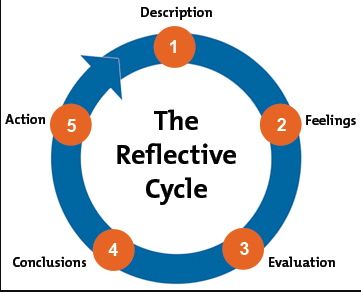

Figure 1: Gibbs reflective cycle
(Source: Adani et al. 2020)
According to the first stage of the Gibbs model, description illustrates the gravity of the situation and what went wrong or right during a specific event, and a conclusion will be drawn later. Therefore, while I was carrying out a business assignment project, I realised the significance of ICT. It is used by all organisations despite its business size and established communication network for business development (Rozmi et al. 2018). Furthermore, I have begun to doubt whether I possessed the knowledge regarding digital, social and economics, which were crucial for the assignment. Economic and social factors are directly related to employment, income, transportation and education (Birnbaum and De Wispelaere, 2020). Although, I took my friends help to complete the project and realised that nowadays, employment data and income statistics could be found on the internet, and both are interconnected. The next stage of the cycle represents feelings related to thoughts and emotions during the experience. After realising how ICT could impact socio-economic factors, I started learning more about those subjects. Therefore, I used ICT and gathered relevant data on economic and social factors for the group assignments. My team members and teachers have shared my concern over the positive impact of ICT on economic and social development.
The third stage of the reflective cycle represents evaluation; it encourages an individual to evaluate things objectively and determine what approaches worked and which ones did not (Adeani et al. 2020). HR plays a vital role in maintaining the organisational culture, which encourages productivity and employee engagement and morale and increases a brand’s reputation (Harrison and Bazzy, 2017). Furthermore, during a group discussion with my team members, I have shared my thoughts on HR’s roles and responsibility towards recruiting skilled candidates so that the organisation could improve productivity and shape organisational culture. However, it is argued that HR offers different training programs that influence employees by honing skills and creating values that will enhance corporate culture (Potnuru et al. 2019).
I agreed with the argument, but during my on job period in a consulting organisation as an HR trainee. I have failed to implement that among employees; therefore, employee’s performance and productivity reduced, but after being consulted with senior HR, I offered training programs specifically designed to improve employee motivation. Thus, I witnessed a healthy organisational function where team members worked together to obtain goals and objectives, which was a profound experience and increased knowledge and skills as an HR on administrative procedures and management to maintain sustainable organisational function.
The conclusion is the fourth stage of Gibbs reflective cycle, which concludes the past experiences and influences individuals to think about the past scenario and questions about alternate approaches (Wain, 2017). Mental health competencies are referred to communication skills, the capability to cooperate with mental health contents and tools in the health advertisement and primary and secondary avoidance care, caring for children with mental health issues (Kratt, 2019). Apart from that, during a research practice as an HR trainee, I was unaware of the importance of mental wealth competencies and did not take employee’s tests. Although that was part of human resource management, my negligence cost that company a considerable time, and employee retention was going down. Simply because I did not take tests and, therefore, failed to address the positive and negative traits of the employees.
However, suppose I have taken an alternate decision. In that case, I could have been able to address the issues among employees and establish mental wealth competencies so that both I and employees could improve insufficient areas in personality. The final stage of the reflective cycle dictates the action plan. An individual is ready to take decisive actions in the present scenario based on the analysis of the previous encounters (Sekarwinahyu et al. 2019). Therefore, it compels me to make the right decisions this time. First, the importance of ICT was previously not clear to me; thus, I could not put specific data in regards to socio and economic factors in the assignment. After gaining much knowledge from reading and practising, I could efficiently conduct duties and jobs related to information and communication technology and analyse the socio-economic impact by collecting necessary data from the internet. Therefore, it would also test my knowledge on HRM functions in the organisational culture, and practical implementation of the HR role for employee management would enhance my learning experiences.
Discussion and recommendations
Extroversion
Based on the big five personality test, I have learned what my assumptions are during the test. The lower score on extraversion makes me believe that I’m an introvert. Introverted persons are quiet, reserved, calm and thoughtful, and prefer no special attention and social engagement (Kamal and Radhakrishnan, 2019). However, while I often work alone, I face challenges due to the laciness of technical skills and knowledge. Therefore, I have to improve my technical knowledge and skills, or I will have to depend on others.
OPENNESS TO EXPERIENCE
Based on lower scores on openness to experience makes I think that my assumptions are wrong. I’m an introvert; therefore I find traditional approaches comfortable and like to conventionally. However, that stops me from learning new things, which would contribute to my knowledge and skills. Consequently, I have to make more development to get out of traditional and limited approaches in learning.
CONSCIENTIOUS
According to the score on conscientiousness from the big five-personality test, it is safe to assume that I am a conscientious person who loves to work a lot. However, that does not help me to be organised in work. Instead, I prefer flexible plans. Therefore, I often change my mind in the middle of work, which is problematic for my team members and me.
Agreeableness
Before the score, I knew I was an agreeable person. After the result, I realised that I’m a disagreeable person. Disagreeable individuals are selfish in nature and lack empathy (Dåderman and Ragnestål-Impola, 2019). Therefore, I prefer competition over cooperation, which is not suitable for me, and I weigh down my ability to work as a team. Therefore, more development is required so that I could incorporate it into the workplace with team members.
A CIPD professional plan is provided below based on my recently discovered weakness after the big five personality tests. The program will suggest potential resolutions to improve these negative aspects of my personality.
| Target | Techniques and strategies | Assets | Time span | Measurement of success |
| Technical skills and knowledge | 1. Reading technical books and journals.
2. Browsing up online classes and tutorials 3. Learning new technical skills from professionals in the workplace 4. Practicing a lot on the computer
|
Books on technical knowledge, journals, PDFs, online classes, computers | Six months | I can solve technical issues in the work
I can address the issues in the system.
I am conducting technical assignments all by myself. |
| Open to learning new things | 1.Watching documentaries, 2.learning visually, 3.reading books on different topics,
4.meeting people from different background |
Online classes, books on different subjects, documentary videos on diverse topics, pdf, journal, article, newspaper articles | Five months | Understanding documentaries.
Finding out alternate solutions to deal with an issue in the workplace. Understanding the point of view of people from different backgrounds. |
| Organised planning | 1.Time management in the workplace and home
2.coordinating resources at the work 3.reading books on organised plans
|
Books on organised planning, online classes, PDF, journals, articles, computer | Six months | I can make presentations in an organised fashion.
Meeting deadlines for the tasks.
Agreeing decisions in team leaders decisions at work. |
| Cooperative | 1. Listening to team members suggestions at work
2. reading books on cooperation 3. Making effective use of nonverbal communication at work |
Books, PDF, journals, online classes, email, hangout | Four months | Assisting team members at work.
Working effectively with team members
I was discussing with team members about issues at work. |
Table: CIPD professional plan
(Source: Created by the learner)
Conclusion
Based on the above analysis, I have concluded that reflection writing is good for self-expression on different learning experiences. I have utilised Gibbs reflective cycle to reflect on my knowledge, skills and past experiences and illustrated the usefulness in the present. I have analysed my deficiencies that I have learnt after the extensive five personality tests. Furthermore, I have made CIPD professional plan to mitigate those negative traits to thrive at work and personal life.
References
Adeani, I.S., Febriani, R.B. and Syafryadin, S., 2020. USING GIBBS’REFLECTIVE CYCLE IN MAKING REFLECTIONS OF LITERARY ANALYSIS. Indonesian EFL Journal, 6(2), pp.139-148.
Adeani, I.S., Febriani, R.B. and Syafryadin, S., 2020. USING GIBBS’REFLECTIVE CYCLE IN MAKING REFLECTIONS OF LITERARY ANALYSIS. Indonesian EFL Journal, 6(2), pp.139-148.
Birnbaum, S. and De Wispelaere, J., 2020. Exit strategy or exit trap? Basic income and the ‘power to say no’in the age of precarious employment. Socio-Economic Review.
Dåderman, A.M. and Ragnestål-Impola, C., 2019. Workplace bullies, not their victims, score high on the dark triad and extraversion, and low on agreeableness and honesty-humility. Heliyon, 5(10), p.e02609.
Delmas, P.M., 2021. Creation of an Off-campus Domestic Program Assignment: A Reflective Account. Innovative Practice in Higher Education, 4(2).
Harrison, T. and Bazzy, J.D., 2017. Aligning organisational culture and strategic human resource management. Journal of Management Development.
Kamal, A. and Radhakrishnan, S., 2019. Individual learning preferences based on personality traits in an E-learning scenario. Education and Information Technologies, 24(1), pp.407-435.
Kratt, D., 2019. Teachers’ perspectives on educator mental health competencies: A qualitative case study. American Journal of Qualitative Research, 2(1), pp.22-40.
Potnuru, R.K.G., Sahoo, C.K. and Sharma, R., 2019. Team building, employee empowerment and employee competencies: Moderating role of organisational learning culture. European Journal of Training and Development.
Rozmi, A.N.A., Nordin, A. and Bakar, M.I.A., 2018. The perception of ICT adoption in small-medium enterprise: a SWOT analysis. Int. J. Innov. Bus. Strat.(IJIBS), 19(1), pp.69-79.
Sekarwinahyu, M., Rustaman, N.Y. and Widodo, A., 2019, November. Problem-based learning skills and reflection skills of biology education students through the problem-based online tutorial. In Journal of Physics: Conference Series (Vol. 1280, No. 3, p. 032004). IOP Publishing.
Wain, Amanda. (2017). Learning through reflection. British Journal of Midwifery. 25. 662-666. 10.12968/bjom.2017.25.10.662.
Know more about UniqueSubmission’s other writing services:
